
Mitochondrial science
Mitophagy is not the same as more energy
The most successful marketing idea in the longevity category rests on collapsing two different processes into one word. Separating them changes what you should expect.
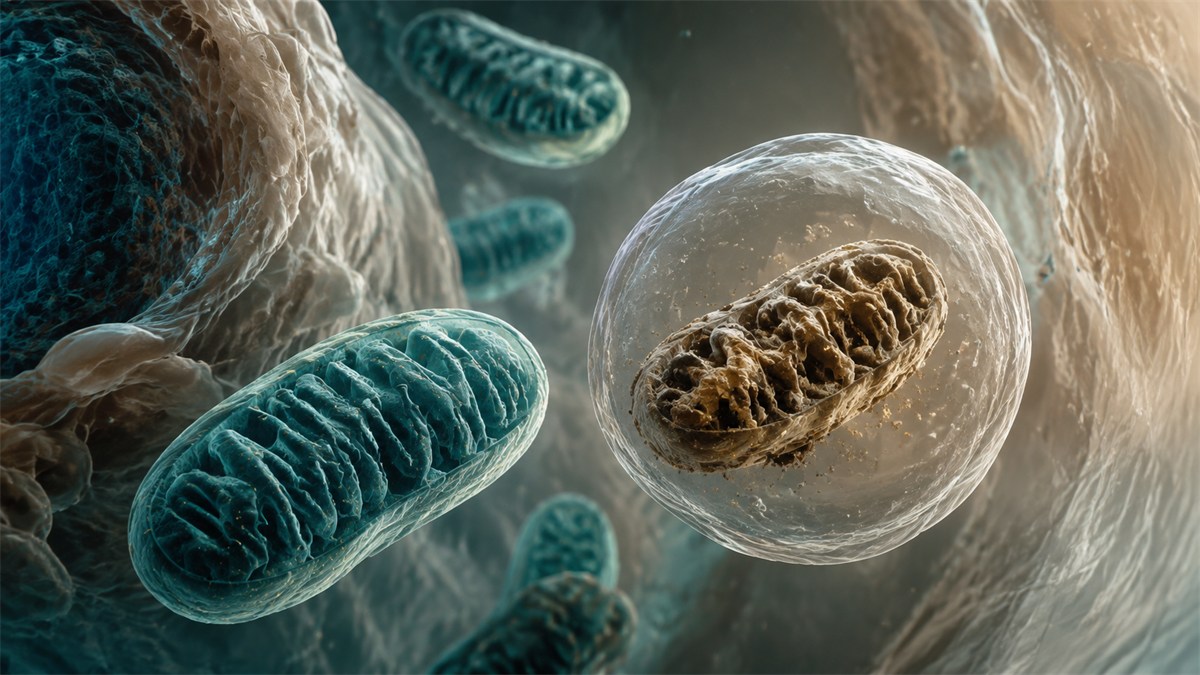
Almost every mitochondrial supplement is sold on the promise of energy. The underlying research is usually about something else entirely: the removal of damaged organelles, which is a maintenance process with no reason to produce a sensation.
The short version
- Mitophagy is the selective clearing of dysfunctional mitochondria. It is quality control, not capacity building.
- Mitochondrial biogenesis, the creation of new mitochondria, is a separate process driven most reliably by training.
- Urolithin A's research programme is built on mitophagy, and its measured outcomes are muscle endurance and strength rather than subjective energy.
- Nothing in this literature predicts that you will feel more energetic, and trials generally have not measured that.
Two processes, one marketing word
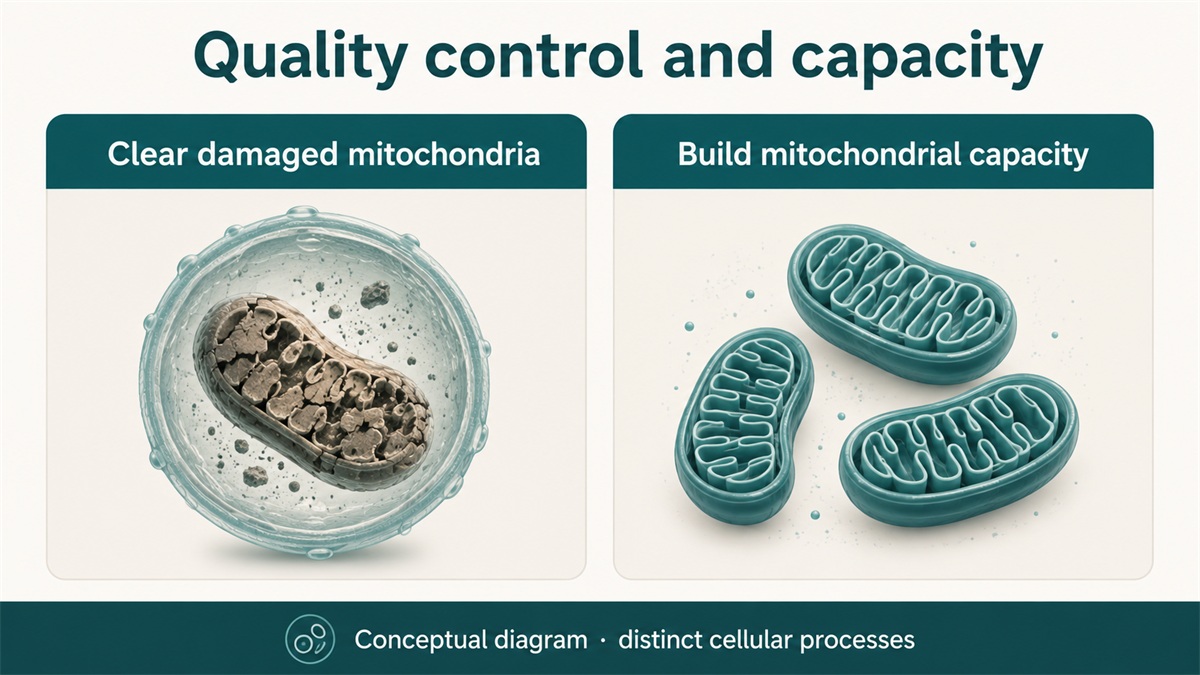
Mitochondria degrade with use. Damaged ones leak reactive species and produce energy inefficiently, so cells tag and dismantle them through a pathway called mitophagy. That is a cleanup operation, and its benefit is that the remaining population works better.
Separately, cells can build new mitochondria, a process called biogenesis, which increases total capacity. Endurance training is the most reliable known driver of it, and the effect sizes are large and well characterised.
Supplements marketed for mitochondrial health almost always act on the first process while being sold in the language of the second. The two are related but they are not interchangeable, and only one of them plausibly changes how much work you can do.
What the trials actually measured
Take the best-supported example. Urolithin A, produced in the gut from ellagitannins in pomegranate and some nuts, promotes mitophagy. Its randomised human trials measured muscle strength, exercise performance, and mitochondrial biomarkers, and reported improvements in muscle endurance alongside increased expression of mitochondrial genes.
Notice what is absent from that endpoint list: subjective energy, alertness, fatigue. Those are not what the research programme was designed to detect, which is why a consumer who buys the product expecting to feel different is running an experiment nobody in the literature has run.
Cellular energy is doing an enormous amount of work in this category, because it means nothing specific and everyone reads it as feeling less tired.
Velmixa Review
Where the confusion is useful to somebody
Cellular energy production is a technically accurate phrase for what mitochondria do. It is also a phrase that a shopper reads as I will be less tired. That gap between the technical meaning and the received meaning is where a great deal of this category lives.
The regulatory framing reinforces it. A structure-function claim about supporting cellular energy metabolism is permitted and largely unfalsifiable. A claim that a product reduces fatigue would invite scrutiny about evidence. So the permitted phrase gets used and the shopper supplies the interpretation.
What to expect instead
If a mitophagy-targeting compound works as its trials suggest, the effect is modest improvement in muscular endurance measured over weeks to months, most clearly in middle-aged and older adults. It is not a sensation. You would detect it, if at all, by noticing that a familiar workload got slightly easier.
If you want an intervention that raises mitochondrial capacity and that you can actually feel, the answer has been the same for fifty years and it is aerobic training. That is not a rhetorical point; the effect sizes are not close.
Two levers, side by side
Mitophagy clears dysfunctional mitochondria. Targeted by urolithin A and related compounds. Measured outcomes so far are muscle endurance and mitochondrial gene expression, over weeks to months.
Biogenesis increases mitochondrial number and density. Driven most reliably by endurance training. Effect sizes are large, well replicated, and visible in performance.
Training also stimulates mitophagy, which is one reason supplement trials in trained populations show smaller effects than trials in sedentary or older ones.
Common questions
Should I feel anything from a mitochondrial supplement?
The trials do not predict a sensation. If a product is marketed on how you will feel, that expectation is coming from the marketing rather than the research.
Does training make these supplements redundant?
Not necessarily, but training acts on the same systems more powerfully, and trials in already-trained people tend to show less. The supplement case is strongest in older or less active populations.
Is pomegranate juice enough?
Only if your gut bacteria convert ellagitannins to urolithin A, and a substantial proportion of people convert poorly or not at all.
Sources
- Urolithin A and spermidine: the mitochondria-first approach to healthy aging — https://medicalnewsbulletin.com/urolithin-a-spermidine-the-mitochondria-first-approach-to-healthy-aging/
- Comparative narrative review of urolithin A, spermidine and NAD+ precursors — https://doi.org/10.4236/jbm.2026.145031
- Comparative evaluation of urolithin A and spermidine — https://www.preprints.org/frontend/manuscript/256c2c55c82e31c98d0d1f23464513a3/download_pub