
Training for healthspan
VO2 max is the healthspan metric with the least argument attached
Among everything measured in this field, cardiorespiratory fitness has the most consistent relationship with outcomes and the fewest people disputing it.
Longevity discourse generates disagreement about almost everything. Cardiorespiratory fitness is the closest thing to a consensus position, and it is notable how rarely it dominates the conversation.
The short version
- VO2 max measures maximum oxygen uptake and is the standard index of cardiorespiratory fitness.
- Its association with all-cause mortality is strong, graded, and consistent across large cohorts.
- Unlike most biomarkers, it is directly modifiable through training, with well-characterised protocols.
- Wearable estimates are convenient and considerably less accurate than laboratory measurement; trends matter more than the number.
What it measures
VO2 max is the maximum rate at which your body can take in, transport, and use oxygen during intense exercise. It integrates cardiac output, blood oxygen carrying capacity, capillary density, and mitochondrial function in muscle, which is why it summarises so much physiology in one number.
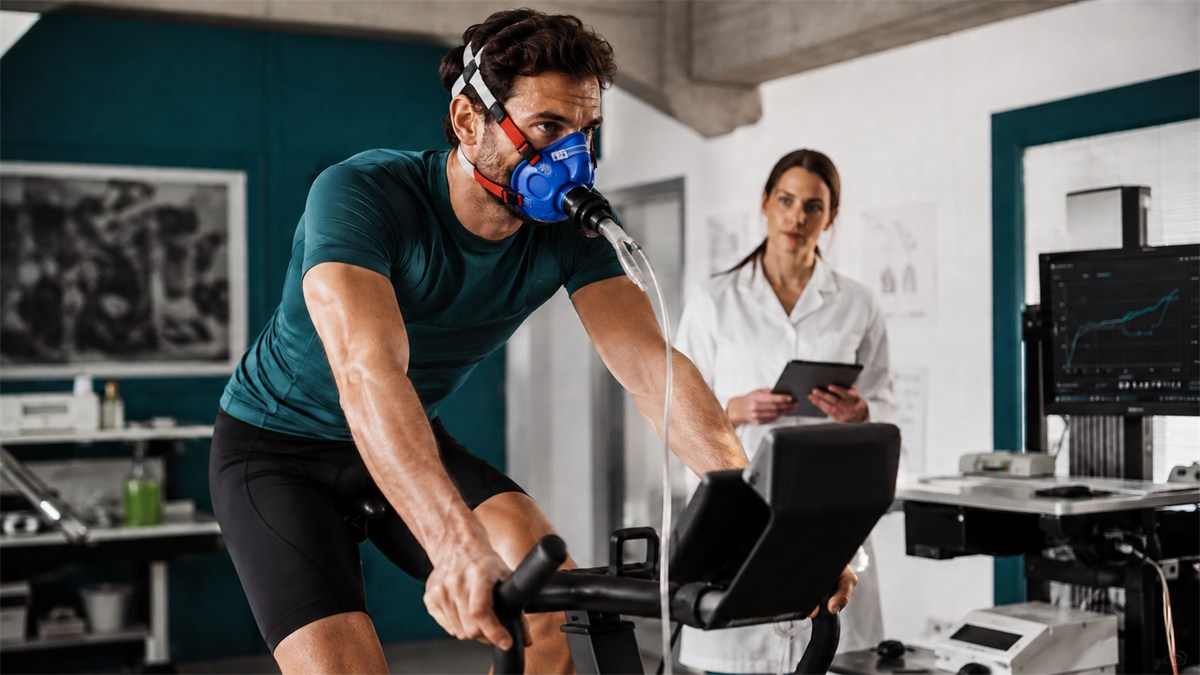
It is measured properly with a graded exercise test and a metabolic cart. Wearable estimates infer it from heart rate and pace relationships during ordinary activity, which is convenient and much rougher.
Why the association is taken seriously
The relationship with all-cause mortality across large cohorts is strong and graded, meaning higher fitness associates with lower risk across the range rather than only at the extremes. It holds after adjustment for the usual confounders, and the largest relative gains appear at the bottom of the distribution.
That last point is practically important. Moving from very low fitness to merely below average is associated with a larger risk reduction than moving from good to excellent. The people with most to gain are the people least likely to be reading about it.
The usual causation caveat applies: these are observational data, and healthy people can exercise more. But fitness is directly modifiable by a known intervention, which is more than can be said for most markers.
It is the rare case where the measurement, the mechanism, and the intervention all point the same way and nobody is selling anything.
Velmixa Review
How to change it
Both ends of the intensity range contribute. Larger volumes of easy aerobic work build the peripheral adaptations, capillary density and mitochondrial content, while shorter high-intensity intervals drive central adaptations including stroke volume.
Most successful programmes use a lot of the former and a small amount of the latter. The specific distribution matters less than consistency across months, and improvements in previously untrained people can be substantial within twelve weeks.
Measuring it
Graded exercise test with gas analysis. Accurate, requires a facility, and useful as a periodic anchor rather than a routine measure.
Inferred from heart rate and pace. Absolute values can be off by a meaningful margin; the trend over months is the usable signal.
Timed distance runs and step tests. Cheap, reasonably repeatable, and dependent on pacing skill and motivation on the day.
Common questions
Is my watch's number accurate?
Treat it as an estimate with real error. Its value is in the direction of travel over months, not the absolute figure.
How fast can it improve?
Untrained people often see meaningful improvement within eight to twelve weeks of consistent training. Gains slow considerably as fitness rises.
Sources
- 26 longevity trends for 2026 — https://honehealth.com/edge/longevity-trends/
- Nine longevity trends for 2026 — https://never2late.substack.com/p/9-longevity-trends-for-2026